
“We live and breathe diversity at the University of Bern – on a professional and on a personal level.”
Adrian Leemann has been a Professor of German Sociolinguistics at the University of Bern since September 2022. He currently heads the Institute of Germanic Languages and Literatures. In this interview, Adrian Leemann shares his thoughts about linguistic identity and fostering an open culture within his team – and why he views the University of Bern as an ideal hub for cross-disciplinary dialogue.
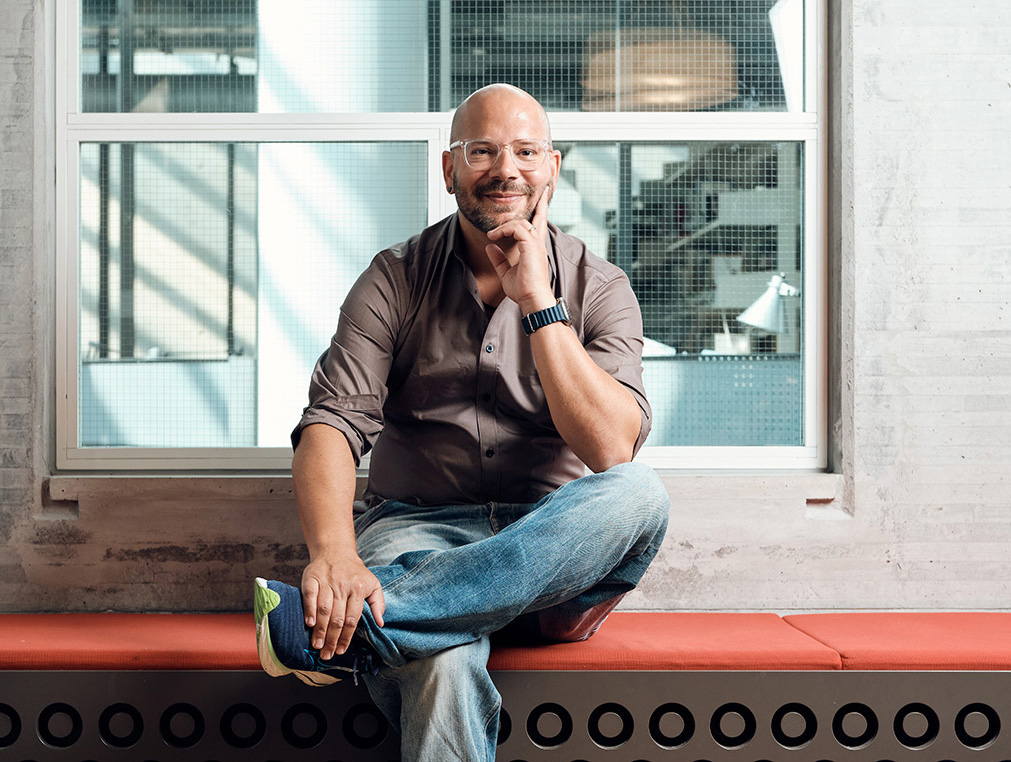
Interview with Adrian Leemann, Professor for Sociolinguistics
How does your work contribute to society?
My research includes exploring the connection between dialects and social identity – a topic that is close to the hearts of many in Switzerland. Our language is a central part of our daily lives, of our socialization and our understanding of self. Dialectology sheds light on how language shapes and reflects our sense of belonging, values and biographies. It offers a lens into social diversity and fosters greater mutual understanding.
How have you experienced the work culture at the University of Bern so far?
As very open and appreciative. I work with colleagues from diverse backgrounds who bring a wealth of perspectives – this diversity makes working together so interesting. There is a high level of transparency, objectivity and humanity in our communication. We always treat each other as equals, even when having heated debates.
What do you personally contribute to the work culture?
I try to address things openly, to communicate clearly and to always consider different points of view. Especially in the humanities, it is important to embrace shades of grey and to allow differing opinions to coexist. This creates space for dialogue, professionally as well as interpersonally.
Which of the University of Bern’s values resonates most with you?
“UniBE is quintessentially Bern” – is a good fit for me. The city and the University of Bern are open, laid back and down-to-earth. There is room for honest conversations here – such as talking to historians or philosophers over coffee in the university courtyard. These casual yet inspiring and thought-provoking conversations are pure gold to me – they are what make the University of Bern special.
How have you grown professionally at the university?
I benefit significantly from the interdisciplinary environment and the interactions with my colleagues at the university – all language disciplines are housed under one roof. Distances are short, we all know each other. This makes for easy and rewarding collaboration.
What advice would you give to young researchers who are considering an academic career?
Let your curiosity guide you! Don’t strategize your every move. – but rather invest your energy where your genuine interest lies. If you are passionate about your research, you will find your path. The rest usually takes care of itself.
Was there a particular moment at the University of Bern that shaped you?
Yes, a very personal one: I met my wife in a lecture hall of the University of Bern. That was in the year 2000. Today, we have two children and a dog. That’s why the university also has a very special meaning for me personally.